
When the majestic waves of Baja California Sur break with golden force over the reef, the desire to glide with absolute freedom and control becomes the top priority for those seeking to master the ocean. Achieving that perfect synchronicity with the sea requires understanding wave dynamics, avoiding the usual technical flaws that often sabotage intermediate surfers during their intense practice days. Stay with us until the end of the text, where we will reveal the ultimate keys that will completely transform your performance in the water.
Watching the horizon with close attention and infinite patience, you notice the perfect set approaching, the kind that promises a pure rush of adrenaline if you manage to react in time with the proper technique. Unfortunately, many athletes miss the opportunity of a lifetime due to poor posture, a subtle detail that ruins the take-off immediately before standing up. Continue reading this article to discover how to optimize every body movement, thus guaranteeing that no promising wave escapes your control in your next session.
Understanding the behavior of the sea is vital, as currents change constantly, demanding an immediate physical adaptation that can only be achieved through theoretical knowledge and constant practice. By mastering the fundamentals outlined below, you will notice a highly rewarding evolution, which will allow you to fully enjoy surfing in Cabo. Join us on this detailed journey and learn to correct those small bad habits that, without you realizing it, are limiting your true potential on the board.
The Perfect Take-Off: Eye Positioning and the Destiny of Your Trajectory
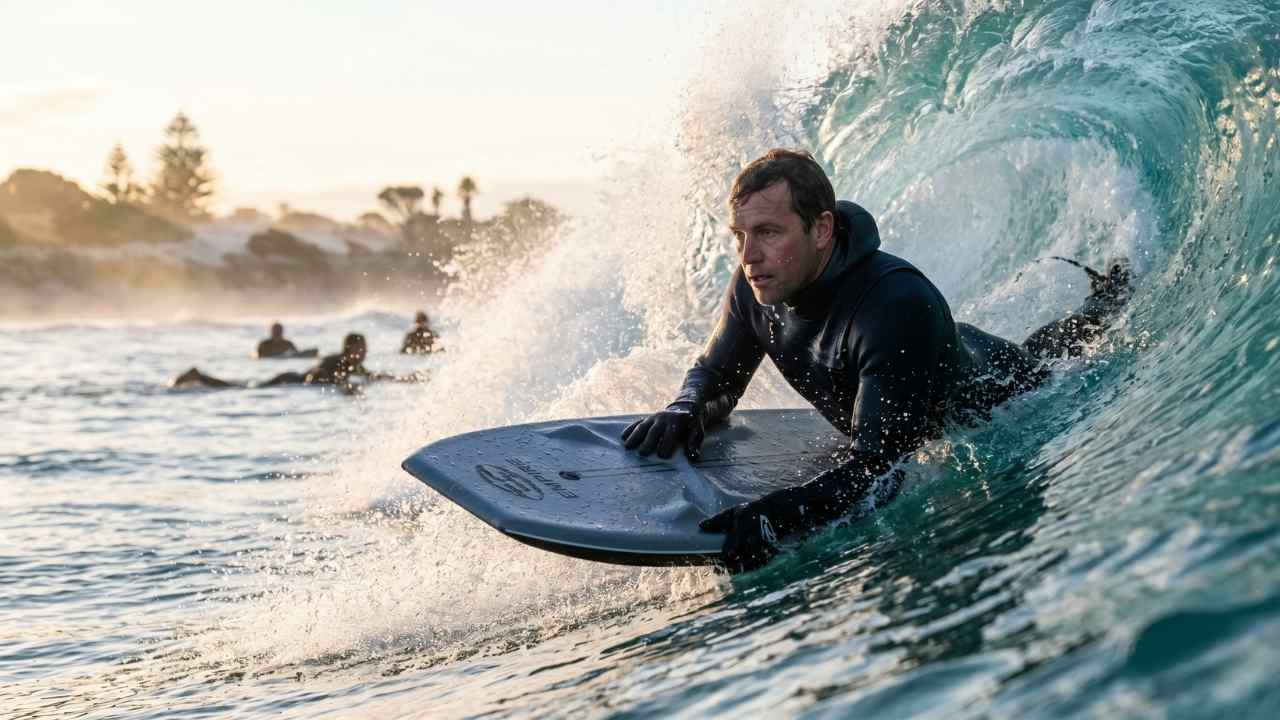
Staring fixedly at the nose of the surfboard—a very common bad habit among beginners—usually completely destabilizes your balance by interrupting the natural flow of the movement. Centering your eyes on the bottom of the water causes an inevitable free fall, which is why it is essential to direct your gaze toward the wall of the wave you intend to ride smoothly. Always keep your head up to anticipate the behavior of the break, achieving a smooth and highly effective transition.
When you orient your vision toward the clean section, your body follows the indicated direction organically, distributing forces evenly across the board. The current marine dynamics in the peninsula, whose conditions change rapidly, require ultra-fast visual reading, which determines the success of the take-off in critical zones. If you want to perfect this crucial aspect, we recommend visiting our space at surfing-lessons-cabo-san-lucas-del-cabo-surf-shop, where you will learn to coordinate your body efficiently.
Guided by experienced instructors on local beaches, students discover that a simple change in visual perspective radically increases the percentage of successfully ridden waves. Don’t let anxiety force you to look down, as the secret lies in projecting your trajectory toward the exit of the pocket, ensuring a long and exciting ride. Focus your attention on the horizon and let natural reflexes guide your lower extremities toward resounding success.
Wrong Placement of Hands on the Board Rails
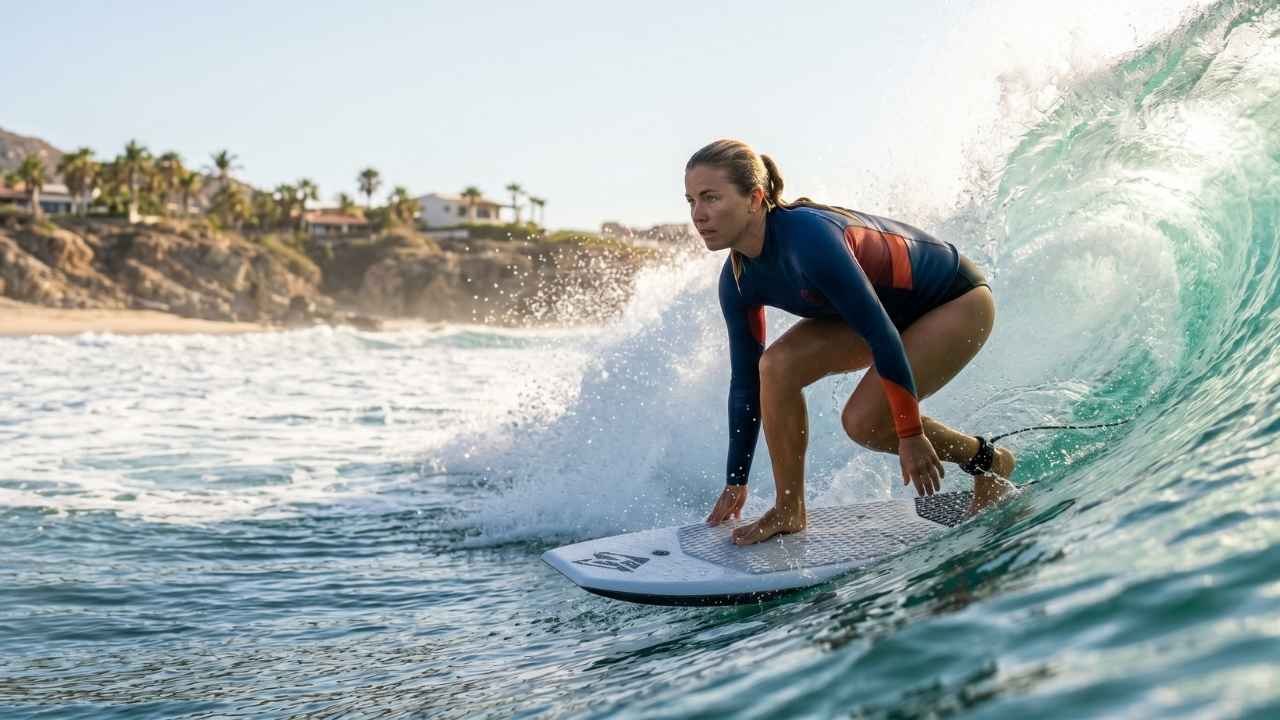
Placing your hands directly on the side edges—a defective technical gesture commonly known as grabbing the rails—removes crucial stability during the vertical pop-up. This destabilizing action twists the foam surface, causing an unwanted asymmetrical sinking that slows down the speed accumulated during the paddle prior to take-off. Place your palmas completely flat on the deck, right at chest level, guaranteeing a firm and centered support.
By pushing firmly against the rigid surface of the board, you create the necessary physical space for your legs to slide smoothly forward without tripping. Executing this movement with surgical precision prevents dangerous nose-dives, which tend to undermine the athlete’s confidence in medium or large wave conditions. Make sure to keep your elbows tucked into your torso, optimizing the leverage required to project your body with agility.
Remembering that body symmetry is indispensable, every centimeter of lateral deviation directly influences the hydrodynamic behavior of your surf equipment. Support defects modify the center of flotation, causing a deviation from the original trajectory that will prevent you from connecting with the fastest section of the wave. Practice this movement on the sand until it becomes a purely mechanical and automated reflex.
Inadequate Weight Distribution and the Wave Retention Effect
Keeping your center of gravity too far back—an error conditioned by the natural fear of nose-diving—prevents the board from planing properly on the hydrodynamic slope. By getting trapped on the upper crest due to a lack of inertia, the surfer loses driving energy, watching the opportunity vanish inexorably toward the deserted shore. Shift your torso slightly forward to tip your weight subtly, allowing gravity to work in your favor.
Likewise, arching your back excessively during the critical acceleration phase helps regulate the pressure exerted, keeping the nose floating just above the choppy water. On the beaches of San José del Cabo, where the summer swell of this year 2026 presents highly vertical acceleration sections, the milimetric positioning of the body defines the boundary between success and a wipeout. Adjust your posture with determination to synchronize your speed with the natural rhythm of the sea.
Therefore, learning to slide your chest a few centimeters toward the front section guarantees a clean and fast entry into the smoothest undulations. Avoid muscle rigidity that freezes your movements, adopting a flexible and reactive attitude that allows you to modify weight distribution according to the demands of the marine relief. Understanding this subtle energy transfer will grant you absolute control over any type of craft.
Insufficient or Poorly Timed Paddling Before the Critical Take-Off
Starting the movement of your arms too late, or applying an intermittent force that lacks the required intensity, prevents you from reaching the minimum speed necessary to match the marine wave firmly. The lack of chronological synchronization causes the breaking wave to overtake the athlete, leaving them stranded in the white water without any possibility of standing up elegantly. Imprint constant power into your strokes during the final meters, ensuring optimal acceleration.
Watching the base of the swell to calculate the exact moment, you will notice how buoyancy changes, indicating it is the precise instant to deliver the final deep paddles. The specific currents of the Mexican Pacific, whose characteristics demand excellent physical conditioning, reward the determination of the dedicated athlete looking to maximize every entry into the sea. Visualize the ideal line of the ride and execute the movement with absolute determination and no hesitation.
However, making desperate and uncoordinated movements only succeeds in fatiguing your upper muscles, decreasing the technical efficiency of the perfect take-off you so desperately want to achieve. Maintaining a fluid yet highly powerful rhythm allows you to conserve the energy necessary for the subsequent execution of maneuvers on the clean wall of the wave. Dose your strength intelligently, reading the environment to act only at the most opportune moment.
Slow Pop-Up and Lack of Agility in the Lower Extremities
Executing the transition to the vertical position by dividing the movement into several intermediate steps negatively affects the overall stability of the stance, destroying the constructive inertia achieved. Placing your knees on the wax surface—a harmful habit that is difficult to eradicate—slows down the dynamic process of taking off, exposing you to the impact force of the whitewash. Bring your feet to the central axis in a single explosive movement, coordinating arms and legs simultaneously.
Considering that the time available in the take-off zone is extremely limited, neuromuscular reaction speed becomes the determining factor of the session. If you feel that your movements lack the necessary elasticity, you can contact us directly via WhatsApp by clicking on this personalized link for direct attention from Surf Shop Cabo, where we will guide you step by step.
In this way, training muscle memory out of the water through specific agility exercises will noticeably streamline your technical response when you find yourself surrounded by real waves. Speed in placing your foot support will grant you a solid and indestructible base, ideal for facing the most challenging sections with total confidence and security. Go for fluidity of movement and say goodbye forever to hesitations on the deck.
Final Perspectives for Constant Evolution in the Ocean
Overcoming the described technical obstacles requires a balanced combination of patience, meticulous observation, and deep respect for individual learning processes in the marine environment. Every entry into the sea represents an invaluable opportunity to reconfigure muscle memory, assimilating the small adjustments that transform a failed attempt into a memorable and perfect ride. Long-term success on the beaches of Baja California Sur belongs to those who persevere with humility, enjoying every small victory over the waves of the Mexican coast.